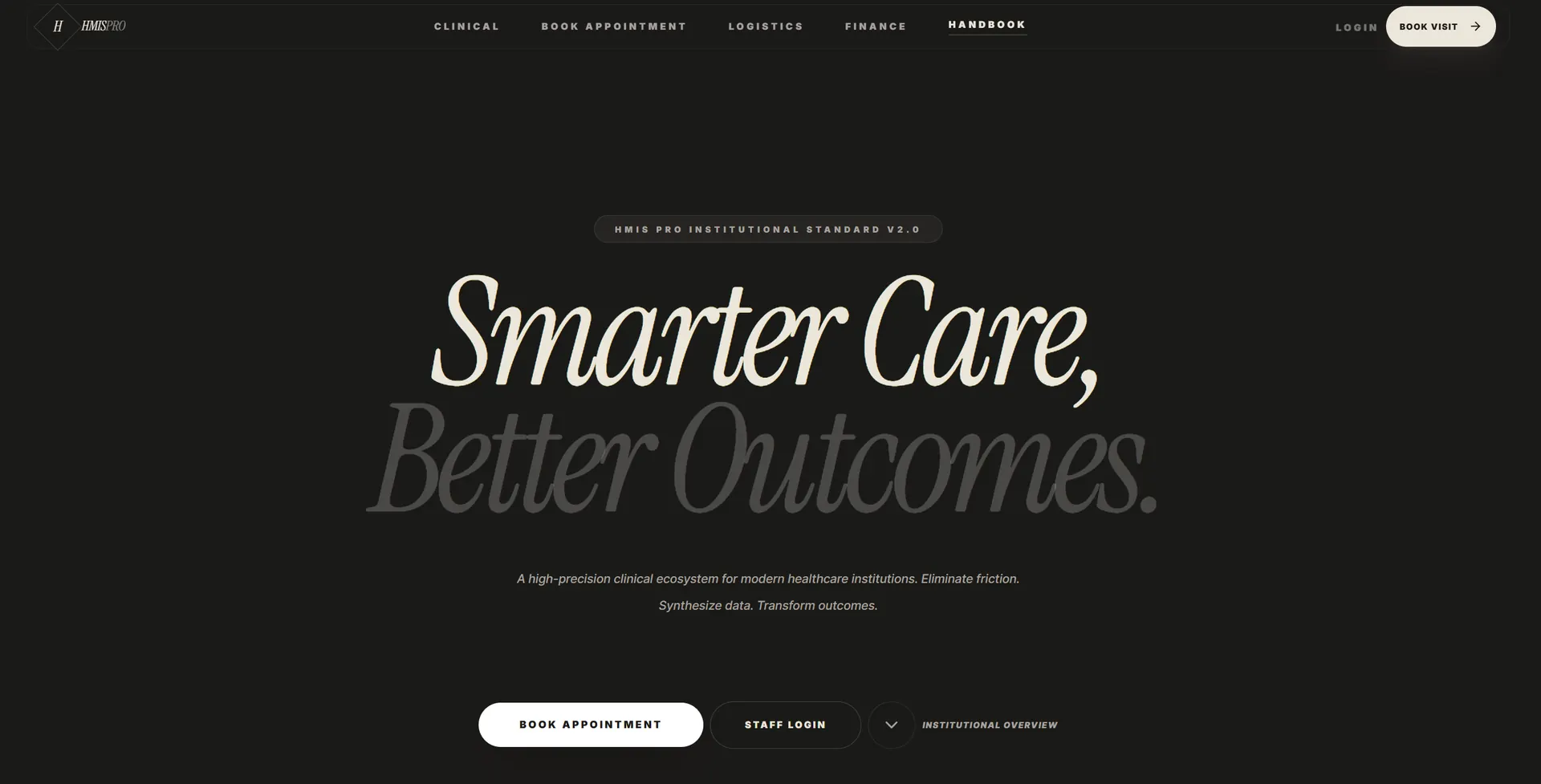
What is HMIS? In a hospital, HMIS means hospital management information system. It is the operational software that keeps outpatient visits, laboratory work, pharmacy, and the revenue cycle on one patient record. People also search those four letters for the Hazardous Materials Identification System printed on chemical labels. This page is about the hospital system.
If you are comparing products for a hospital in Pakistan, the practical version of that definition is on our hospital management software Pakistan page, built around HMIS Pro.
What a hospital management system covers
A hospital management system is useful when the departments that touch the same patient stop keeping separate books.
- OPD. Registration and the visit itself, so the next department is not retyping the patient.
- Labs. Orders and results, including lab analyzer interfacing over RS232 and TCP/IP when those machines are in scope.
- Pharmacy. Dispensing, and pharmacy-claims integration when the hospital's payers are part of the rollout.
- Revenue cycle. The charges that those clinical steps create, kept with the encounter instead of reconstructed at the counter.
A standalone billing tool, a standalone laboratory system, or a spreadsheet at reception can each be part of the hospital's day. They are not an HMIS until the hospital can follow one patient across them.
Hospitals that keep clinical operations running through a long day feel this first. The night admission, the morning lab, and the discharge bill are the same stay. The system has to treat them that way.
HMIS, HMS, and hospital information system
Buyers in Pakistan will see HMIS, HMS, and hospital information system used for the same kind of product: software that runs the hospital, not a single department. HMIS (hospital management information system) is the long form. HMS (hospital management system) is the shorter search phrase. A hospital information system often means the same operational scope.
The acronym is not the decision. The decision is which journeys are in the quote: registration to consultation, diagnostic order to result, medicine receipt to dispensing, invoice to reconciliation.
What an HMIS is not
An HMIS is not the chemical hazard label. If you need an HMIS rating, an HMIS number, or a diamond for a safety data sheet, you are in a different industry.
It is also not a promise that every analyzer, imaging archive, or payer is already connected. HMIS Pro offers LIS, RIS, and PACS integration support, and it interfaces with lab analyzers over RS232 and TCP/IP. The systems in a given hospital are named in the scope. HRMS and payroll integration, and pharmacy-claims integration, are offered the same way.
It is not a fixed-price package. Hospital management system cost depends on modules, migration, integrations, infrastructure, and training. HMIS Pro is quoted from that scope.
What HMIS Pro includes
HMIS Pro is QuantaloomAI's hospital management system. It is deployed at a private hospital. We do not publish that hospital's name.
The product unifies OPD, labs, pharmacy, and revenue cycle. It uses a PostgreSQL database. A hospital can run it in the cloud or on-premise. The interface is available in 22 languages, including English and Urdu. Data migration and staff training are scoped with each engagement. A typical implementation runs 8–16 weeks.
You can book an HMIS Pro demo before a scoping conversation. The buyer acceptance checklist is the list of scenarios worth demonstrating before go-live. HMIS and clinical AI covers how digitizing operations is phased, and what building a hospital management system taught us about clinical AI records the rules that building HMIS Pro produced.
How to read a proposal
Ask the vendor to write the scope as journeys, not a feature grid. Then ask which of these are inside the number you were given:
- The departments in the first go-live.
- Cloud or on-premise hosting, and who operates it.
- Data migration: which history moves, and who signs it off.
- Each external system: analyzers, LIS, RIS, PACS, payroll, pharmacy claims.
- Staff training, and for which roles.
- What is explicitly out of scope.
That is the same standard we use when we scope HMIS Pro for a hospital in Pakistan. The Pakistan landing page states the commercial shape in one place: a scope-based quote, 8–16 weeks, with HMIS Pro deployed at a private hospital.
*Written by Sharjeel Ahmed, QuantaloomAI. Book a briefing or contact the studio with the departments and systems you want in scope.*
Questions this page answers
- What does HMIS stand for?
- In hospital software, HMIS stands for hospital management information system: the system that runs clinical departments and billing together. The same letters also name the Hazardous Materials Identification System used on chemical labels. That is a different HMIS.
- What is the difference between an HMIS and a hospital management system?
- In hospital procurement they name the same class of software. HMIS stresses the information the hospital manages. Hospital management system is the phrase most buyers search. Judge either one by the workflows in scope, including OPD, labs, pharmacy, and revenue cycle.
- Is HMIS Pro an HMIS?
- Yes. HMIS Pro is QuantaloomAI's hospital management system. It unifies OPD, labs, pharmacy, and revenue cycle, and it is deployed at a private hospital.
- Can an HMIS run in Urdu?
- HMIS Pro's interface is available in 22 languages, including English and Urdu. The hospital chooses cloud or on-premise hosting.
- How is an HMIS priced?
- HMIS Pro is priced as a scope-based quote. Data migration and staff training are scoped per deal. A typical implementation runs 8–16 weeks. There is no fixed price.
Related service AI for healthcare · HMIS Pro · Hospital management software in Pakistan